

Cards, IDs and Cashless Play: What Other Jurisdictions Learned Before Illinois
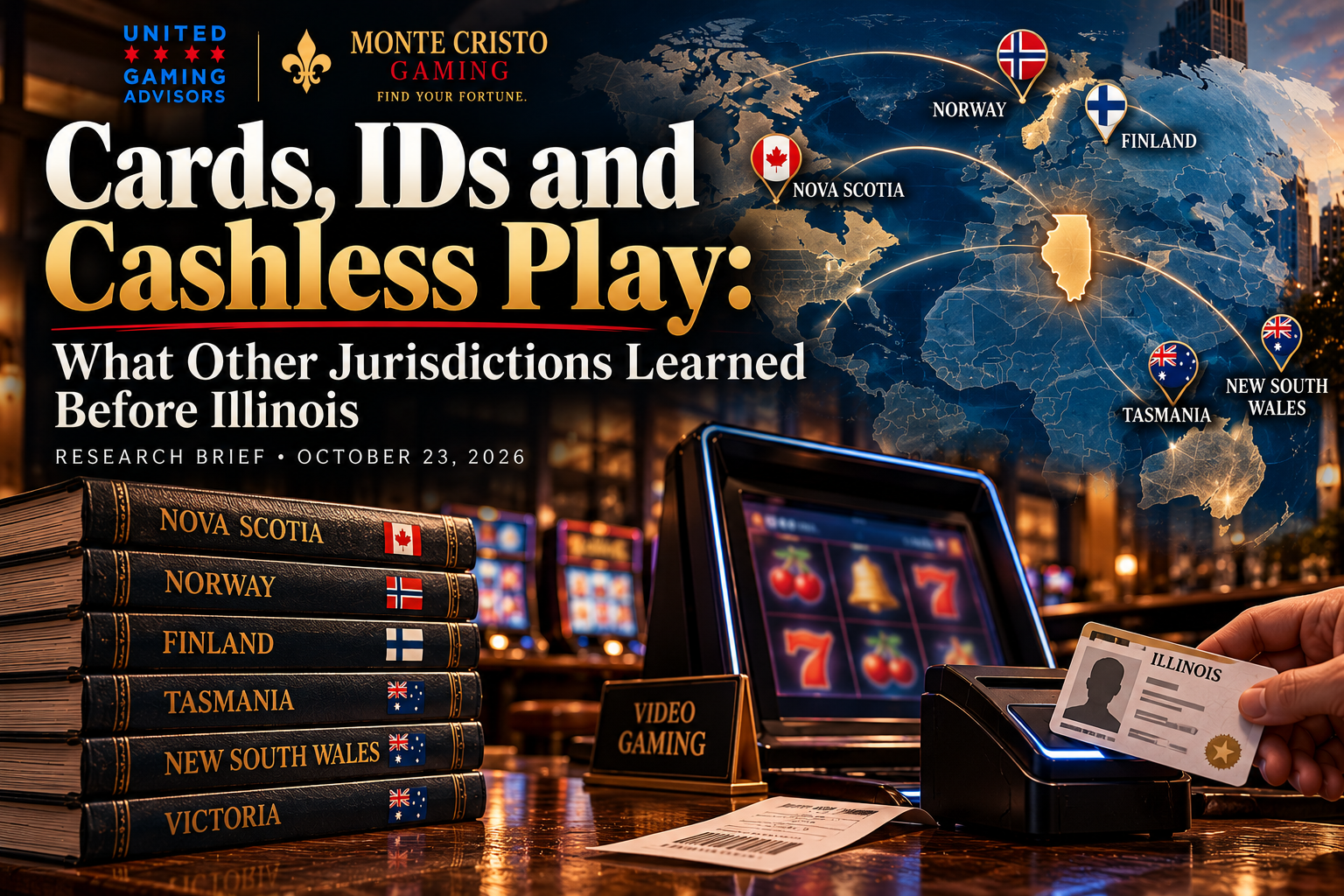
Research brief · October 23, 2026
The short version
Where players were forced onto a card or ID system, play fell, and the programs that lasted paired the mandate with fewer machines or binding limits. Nova Scotia, Norway and Finland all recorded drops, and Nova Scotia scrapped its card after two years. Where the tools were voluntary, almost nobody used them, and where venue owners had a strong voice (Tasmania, New South Wales, Victoria's pubs and clubs), mandates stalled or were swapped for lighter measures.
Illinois is about to attempt this in the largest distributed gaming network in the world, and Fox Rothschild's counsel described the plan as unprecedented at this scale. The design also differs from most of the programs below: an ID reader on the redemption terminal tied to the self-exclusion list, plus TITO, rather than a per-machine card with binding limits.
This article summarizes what Illinois has proposed and what the industry told the IGB. It then walks through seven comparable programs, covering what each did, how it performed, how it was received and what happened to play. A side-by-side chart and takeaways for Illinois operators close it out.
What Illinois has proposed
On Sept. 3, 2026, the Illinois Gaming Board adopted a resolution making ID-gated, ticket-only play its chosen route for bringing video gaming into the Self-Exclusion Program (SEP). It is a policy statement, not yet a rule.
The IGB's release describes the mechanism: identity card readers installed on the redemption terminals already in licensed establishments, working with ticket-in-ticket-out (TITO) technology. Once fully implemented, video gaming terminals (VGTs) will no longer accept or store cash. Patrons will use TITO at the redemption device both to start play and to redeem winnings. The release states that no changes took effect that day. The next steps are technical standards, proposed implementing rules that go through the Joint Committee on Administrative Rules (JCAR), and stakeholder engagement.
The hardware path runs through the state's central system vendor. Capitol News Illinois reported a $162 million, 10-year contract with LNW Gaming to upgrade terminals, with a Dec. 31, 2027 contractual deadline and fines for delay, and said implementation could take more than a year. Fox Rothschild's meeting recap called it a significant policy never implemented in an industry this size. The market in question was 8,799 licensed locations and 50,049 VGTs at the September report.
Three companion rule amendments
Three separate amendments to the existing SEP, which today covers casinos and sports wagering only, were also approved and are headed to JCAR. Capitol News Illinois said that review could take six months to a year.
Tiered exclusion terms. Replaces the five-year minimum with six months, one year, three years, five years and indefinite options.
Expanded enrollment channels. Lets the IGB add notarized mail, treatment-provider referral or an online portal, instead of in-person enrollment only.
Marketing Exclusion List. A voluntary list that extends the ban on targeted marketing for a default 12 months after an exclusion ends. Listed people can still take part in promotions offered to patrons.
Context from the same coverage: nearly 16,000 people are enrolled in the SEP, and a state-commissioned study estimated 383,000 Illinois adults have a gambling problem and another 761,000 are at risk.
How we got here
Sept. 3, 2026: Board resolution endorsing ID card readers on redemption terminals plus TITO; three SEP amendments sent toward JCAR.
July 22, 2025: Statewide TITO enablement set for this date. By February 2026, over 85% of roughly 49,500 VGTs were running TITO, per Fox Rothschild's recap of that meeting.
April 2025: IGB approved a proposed casino rule allowing cashless wallets at all 17 casinos, subject to the credit card ban, SEP controls, age limits and anti-money-laundering rules. I did not confirm whether it has been finalized.
Jan. 13, 2025: Deadline for public comment on a VGT self-exclusion program and cashless technology.
Oct. 24, 2024: IGB opened that comment period at its October meeting.
A note on terms: "cashless" here means VGTs stop touching cash, while cash still goes into the redemption device. Nothing I found says whether mobile wallets will follow for video gaming.
What the industry told the IGB
Almost every commenter backed self-exclusion in principle; the objections were about enforcement, who holds the ID data, and cost. The IGB published the comments it received by the Jan. 13, 2025 deadline.
Illinois Gaming Machine Operators Association (via Taft). Position: Supports the goal; asked for a problem-gambling assessment of video gaming before any rules. Long-time TITO supporter; sees TITO and coinless redemption as stepping stones before full cashless. What they flagged: How the list reaches thousands of locations and whether bartenders and servers must know it; confidentiality, since most locations lack privacy policies; enforcement, with its understanding that BIPA bars facial recognition; hardware costs favoring large operators. On cashless: wants an impact study on revenue, taxes, cost, loss of anonymity, behavior, and any link to player tracking or rewards.
Lattner Gaming (Bobby Walsh, president). Position: Argued a traditional self-exclusion program is very hard in distributed gaming and cited a 2004 Nova Scotia test. Proposed staff training, optional machine-level player tracking with a card or PIN, voluntary limits and awareness messaging. What they flagged: On cashless, proposed a central wallet funded by ACH, cards or PayPal, a small device on each machine's SAS port, and an app delivered through its planned Lattner Loyalty App (as of January 2025).
Illinois Café & Service Co. and Laredo Hospitality (Charity Johns, CEO). Position: Supports a VGT SEP; wants cashless as one option alongside TITO and cash. What they flagged: Mandatory ID scans may deter non-excluded patrons; which IDs count; whether a machine locks after an excluded person scans; who stores scanned data and whether play is tracked or reused by competitors; whether a terminal operator could keep customer data if a location leaves. Suggested an ID check only at cash-out above a threshold, as casinos do at jackpots. Wants loyalty programs tied to the owner or location.
PENN Entertainment. Position: Supports both proposals. What they flagged: Said its cashless system is live at 21 properties in nine jurisdictions, with deposit limits, help links and transaction history.
idPair (Jonathan Aiwazian, CEO). Position: Operates the National Voluntary Self-Exclusion Program. Argued for blocking money from entering a machine until an ID scan clears the player against the list. What they flagged: Said a scan can take under a second, can be retrofitted or built into a bill validator, and need not store any personal data.
OKTO Payments. Position: A wallet vendor; offered to join any working group. What they flagged: Pitched open-banking wallet and compliance products.
Nicasa Behavioral Health (Elizabeth Thielen). Position: Strongly backed a VGT self-exclusion option. What they flagged: Reported a Lake County client who lost over $500,000 on machines.
Individual commenters split on cashless. One opposed it because removing cash removes the reality check of losing real money. A manufacturer sales representative favored wallets, said cash handling and robbery risk would fall, estimated about $360 million sits in redemption terminals statewide (an unverified figure), and suggested terminal operators opt in. Another commenter asked that VGT users be ID'd like any other age-restricted purchase.
Nova Scotia: a mandatory card that lasted two years
Nova Scotia's My-Play card became mandatory on every video lottery terminal in April 2012 and was dropped in August 2014, after the province said it had cut revenue without reducing play by people with gambling problems.
What they did
My-Play gave players their current and past play history and let them set spending and time limits or stop play. The province's gaming overview says it was built into every VLT in 2010-11, with mandatory enrolment on April 1, 2012. The 2011 launch coverage noted that, unlike cards elsewhere, it would not cap how often people could play. I found no source saying it required scanning government ID; registration came in full and "light" (anonymous) forms.
How it performed
The minister said 99.9% of players did not use the features, and that people used multiple cards. The system's creator told CBC that the switch to the temporary light-enrolment card, which recorded no name or history, undermined it, and that roughly 3 million cards were in circulation for fewer than 1 million residents. The total cost was $19.5 million, $13.1 million of it capital; the creator disputes the province's figures.
Reception
The opposition called dropping the card without a replacement "immoral" and accused the government of leaning on problem gamblers to balance the budget. Former minister Graham Steele wrote that many bars, lounges and legions would fold without VLT revenue. The minister also said the province did not want cards drifting toward Air Miles-style loyalty rewards for playing VLTs.
What happened to play
The government attributed a $47.5 million drop in VLT revenue between 2012 and 2014 to the card and said fewer people gambled once it was required. The head of the provincial lottery corporation told legislators that revenue fell 25% when My-Play became mandatory and rose about 11% when it was axed. VLT revenue then grew from $113 million to $132.6 million in 2015-16. The corporation credited terminal replacement and returning casual players, while the opposition blamed problem gamblers.
The 2004 self-exclusion test
Nova Scotia also tested staff-based exclusion before My-Play. In a three-month test (March to May 2004) at 45 retail sites, retailers detected 23% of excluded players' sessions and only 42% of their breach reports were accurate. Detection was 11% in public bars versus 60% in private clubs, and fell from 34% in the first month to 13% in the third. The report concluded that staff recognition was not reliable and recommended machine-level screening such as a player card.
Verdict: a failure on engagement, circumvention, revenue and politics. The sources describe no privacy backlash.
Norway: the card arrived with roughly 80% fewer machines
Norway's mandatory player card has the strongest record of the group, but it came bundled with a bill-acceptor ban, a state monopoly and a machine count cut to about one fifth of the old market.
What they did
Per the Engebø, Torsheim and Pallesen study, Norway had about 19,000 slot machines run by more than 100 private operators in 2001. Bill acceptors were banned on July 1, 2006, and the machines were removed at the end of June 2007. The state operator Norsk Tipping then introduced central-server Multix terminals, mainly from 2009. A player card, and so registered play, was required, which enabled an enforced loss limit, extra restrictions players could set, and self-exclusion.
How it performed and what happened to play
The study's survey data show the share of Norwegians playing slots or Multix falling from 18.7% in 2005-07 to 1.5% in 2008-13, then holding at 1.6% in 2014-18. Overall gambling participation drifted down from 82.1% to 76.3% and then 72.7% across the same periods. Helpline calls fell nearly 70%, from 2,100 in 2005 to 657 in 2008, while gambling revenue fell 33%, from NOK 11.7 billion to NOK 7.9 billion. Problem-gambling prevalence (PGSI 3+) fell from 5.5% in 2005 to 3.0% in 2013, then rose to 4.5% by 2019 as online play grew.
Substitution was real but small: play in bingo halls and on foreign websites rose, by much less than slot play fell.
Reception and leakage
The sources I opened do not document how players or venues felt about the card. They do show that circumvention was an issue: Norsk Tipping's response to a regulator audit (in Norwegian) describes a reinforced Multix login introduced in May 2019 to make it harder for players to get around their limits.
Caveat
The authors say they cannot separate the effects of the bill-acceptor ban, the slot ban and the later terminals. The CBC's reporting on Nova Scotia reached the same conclusion about the card versus the removal of bill acceptors.
Verdict: a success on harm indicators, achieved by shrinking availability as much as by identifying players.
Finland: ID at the slot machine, and a steep fall in slot revenue
Finland is the closest analog to Illinois' plan, because ID checks began at slot machines in shops and bars in January 2021, and slot revenue fell sharply afterward, alongside loss limits and fewer machines.
What they did
Per Deloitte's review, the state operator Veikkaus brought forward a statutory obligation and introduced identification at its distributed slot machines in January 2021, a year ahead of the law's January 2022 effective date. Retail sports betting followed later in 2021, coupon games like Lotto in May 2023, and scratch cards in January 2024, completing identification across every channel. The law also introduced compulsory daily and monthly loss limits and gave health agencies access to player data.
Veikkaus accepted a driver's licence, the national Kela card, a mobile card in its app, or a free Veikkaus card that doubled as a loyalty card. It also gave tickets bought before each deadline a grace period, and added a daily bonus draw when scratch cards required ID.
How it performed and what happened to play
Deloitte reports that slot machine revenue fell from about €683 million in 2019, around 40% of the company's revenue, to roughly €200-220 million in 2022, around 20%. It attributes this to mandatory precommitment and loss limits, with about 50,000 fewer active slot players and a significant drop in machine numbers. Veikkaus's 2023 results show gross gaming revenue of €1,032.0 million, down 3.6%, partly because of the ID requirement on ticket games. They also show that 90.6% of its domestic gambling was by authenticated players. Group operating profit fell 14.5% in 2023 and 19.6% in 2024, which Veikkaus attributes to several factors including taxes and its responsibility measures.
Identification data from 2021 showed that just 7% of players generated 50% of Veikkaus's revenue.
Reception and the wider market
I did not find direct reporting on how players or bar owners reacted at the machines. The broader market picture is that Veikkaus lost ground to offshore operators. Helsinki Times, a source with affiliate-marketing content, reports gross gaming revenue falling from €1.8 billion in 2017 to €931 million in 2025 and the share of play staying in the regulated market dropping from about 90% to about 50%.
Finland is now opening online gambling to private operators in 2027, with Veikkaus keeping its land-based slot machine monopoly and mandatory identity verification extended across gambling.
Caveat
COVID, machine removals, loss limits and offshore competition all overlap with the ID mandate, so the revenue fall cannot be pinned on identification alone. One useful side effect: the identified data became Veikkaus's customer database, which Helsinki Times calls an advantage over incoming competitors.
Verdict: the program lasted and expanded, but the machine business shrank by roughly two thirds.
Victoria, Australia: mandatory at the casino, repeatedly delayed everywhere else
Victoria has required carded play at Crown Melbourne since December 2023, but its mandate for pubs and clubs has slipped through a bill, a trial and a still-unconfirmed statewide start.
What they did
YourPlay, a voluntary statewide pre-commitment system, is installed on every poker machine, and per the Parliament of Victoria debate, using it is optional for players but mandatory for venues to offer. At Crown, players need a valid card with time and loss limits, which they set themselves. The bill passed on May 27, 2025, creating a framework for mandatory carded play. It also moved to cut the cash load-up limit from $1,000 to $100 and set a three-second minimum spin for new machines. A 43-venue trial in Monash, Greater Dandenong and Ballarat was announced for September to November 2025.
How it performed
Crown said more than 400,000 guests registered for carded play in its first 12 months. The regulator censured Crown in August 2025 after 22 customers kept playing past their limits and 10 used cards linked to accounts not in their own name, which the VGCCC called isolated.
Reception
Community Clubs Victoria called the trial's start "bumpy", warned of unbudgeted staffing costs, and repeatedly asked for the Crown evaluation data. A local report said Monash Council and the Alliance for Gambling Reform withdrew support for the trial over unclear timelines and the lack of mandatory pre-commitment. In debate, the opposition said casual punters would be deterred and questioned the magstripe technology, while a Libertarian MP raised data-breach and privacy risks.
What happened to play
I found no published evaluation of the Crown rollout, and the minister declined to commit to making trial findings public. The opposition claimed Crown saw a significant drop in patronage and about 1,000 layoffs after carded play, a partisan claim whose causation is disputed. The minister acknowledged that Crown's photo-ID requirement for non-Australian visitors "had an impact on their bottom line" and hit casual tourists hardest.
Status
In May 2025 the minister said full implementation would not happen before the new monitoring licence in 2027. Some secondary sites claim a statewide December 2025 start, and I could not verify that from an official source.
Verdict: enforceable at a casino where the regulator forced it, still unproven in pubs and clubs.
Tasmania: a card that never launched, replaced by TITO and facial recognition
Tasmania shelved its planned mandatory pre-commitment card before launch and in January 2026 replaced it with ticket-in-ticket-out play, facial recognition and in-venue ATMs, a package its own gaming commission says will "take Tasmania backwards".
What they did
The abandoned card would have capped losses at $100 a day and $5,000 a year, per Focus Gaming News. The government deferred it in late 2024 and said it would return only with a national approach. The January 2026 package, reported by Pulse Tasmania, has these parts:
TITO, with tickets capped at $200 and machines accepting $100 in cash at a time.
Mandatory facial recognition to enforce the state's exclusion scheme, plus immediate self-exclusion through QR codes at venues.
On-site ATMs fitted with facial recognition and daily withdrawal limits.
Shorter venue hours, a measure the Liquor and Gaming Commission said should apply uniformly across venues.
Reception
The hospitality sector had consistently opposed the card and appeared supportive of the replacement package. In letters obtained under right-to-information laws, the three commissioners wrote that they had not been consulted. They warned the ATMs could create greater harm and that TITO systems can raise spending by up to 20%, and they agreed there was a money-laundering risk.
The Treasurer told an upper-house inquiry in October 2026 that the card was "parked" until other states lead, citing operational complexity and cost, including the need for a centralised banking system. A Deloitte report on the abandoned card found mandatory registration and limits would have delivered the strongest harm-reduction outcomes despite potential effects on hospitality. Anglicare Tasmania's chief executive said the replacement measures would have a "minuscule" impact even taken together.
What happened to play
There is no outcome data, because neither package has been fully implemented; the commission has been directed to roll the new measures out progressively by mid-2028. Poker machine losses have kept rising since the end of COVID, including more than $17.7 million in May 2026 alone.
Verdict: the mandate lost to cost, complexity and venue lobbying before launch, and the fallback is the TITO-plus-exclusion model Illinois is already moving toward.
New South Wales: a voluntary digital wallet almost nobody used
New South Wales' cashless gaming trials tested a voluntary digital wallet on thousands of machines, and only 14 people used it in a way the evaluators counted as genuine and active.
What they did
Two early trials ran at Wests New Lambton (144 machines, October 2022 to June 2023) and Club York. The statewide trial ran from March to September 2024, with temporary law changes and voluntary participation. NEXT.io reports it covered 14 venues and 2,388 machines, three technology providers and identity-linked gambling features. The panel also renamed the product a "digital gaming wallet" after "cashless" led patrons to believe cash was no longer accepted.
How it performed
An ABC report on the Wests trial found that interviewed players saw little change in time, money or pace, that participants reverted to what they were used to, and that fewer than a third of 260 participants completed the post-trial survey. Of 10 people who tested limits, five had breaches. In the statewide trial, NEXT.io says only 162 users signed up by August 2024. The ABC reported the A$3.4 million trial had only 14 "genuine and active" participants.
Reception
The Independent Panel on Gaming Reform nonetheless recommended a mandatory statewide account-based system by 2028, with limited cash still allowed, and 30 recommendations in total. The Australian Hotels Association NSW called the findings "embarrassing and not credible" and said the research rested on a survey of two players and an interview with one. ClubsNSW argued that 14 active users called for a cautious, voluntary approach. Reform advocates wanted a mandatory card with binding limits instead.
What happened to play
The Wests venue reported no evidence of revenue changes, and the larger trial did not measure behavior change. Later reporting says the Premier called cashless rollout "largely ineffective" and the government indicated it is unlikely to roll out a full pub-and-club mandate. I did not find an official statement confirming that decision.
Verdict: a voluntary tool that people declined to use, and a mandate recommended anyway but not adopted.
United States: voluntary and operator-run programs in casinos, nothing like this in a route market
The closest U.S. precedents are voluntary or operator-run programs in casinos. I found no U.S. distributed-gaming market that requires ID before video terminal play, and Fox Rothschild's recap called Illinois' plan unprecedented at this scale.
Massachusetts: PlayMyWay
PlayMyWay is a voluntary budgeting tool that rewards-card holders turn on at slot machines. In its first year at Plainridge Park, 8.8% of eligible visitors (8,856 of 101,024) enrolled. Enrolled users had a median daily wager of $347.80 versus $485.30 for non-users, and a median daily loss of $47.50 versus $62.90. Users chose to enroll, so the gap is not proof the tool caused it, and the later Division on Addiction evaluation states that its results are not causal (I could not open the PDF and rely on the excerpt shown in search results). Enrollment has grown: more than 42,000 in 2023 and more than 52,000 actively enrolled as of June 30, 2024.
The same 2018 framework barred credit cards and kept debit withdrawals 15 feet from the gambling area, and it did not allow bank-to-reward-card cashless systems until the commission deemed them safe. I did not check whether that has since changed.
Casino cashless wallets
PENN told the IGB its cashless system is live at 21 properties in nine jurisdictions, with deposit limits and transaction history. The Nevada Independent reports QR-code cashless systems in more than two dozen casinos nationwide, and that Nevada's test lab approved the Acres system in August 2025. Acres cited a study that cashless players buy 92% more credits per session than cash players. That figure comes from the vendor, and a UNLV responsible-gaming expert said research could show either no meaningful change or a measurable negative impact.
An equipment-industry responsible-gaming director told the same outlet that Canadian provinces made VLT tools mandatory, and dropped the requirement when revenues plummeted, which matches the Nova Scotia record above.
What happened to play
There is no U.S. dataset comparable to Nova Scotia's or Finland's, because none of these programs is mandatory. The one relevant Illinois proposal covers casinos: the IGB's April 2025 rule would allow digital wallets at all 17 casinos under the credit card ban, SEP controls, age limits and anti-money-laundering safeguards.
Verdict: carded and cashless tools in U.S. casinos are voluntary or tied to loyalty programs, the opposite of the mandatory, anonymous-by-default VGT environment Illinois is changing.
Side by side
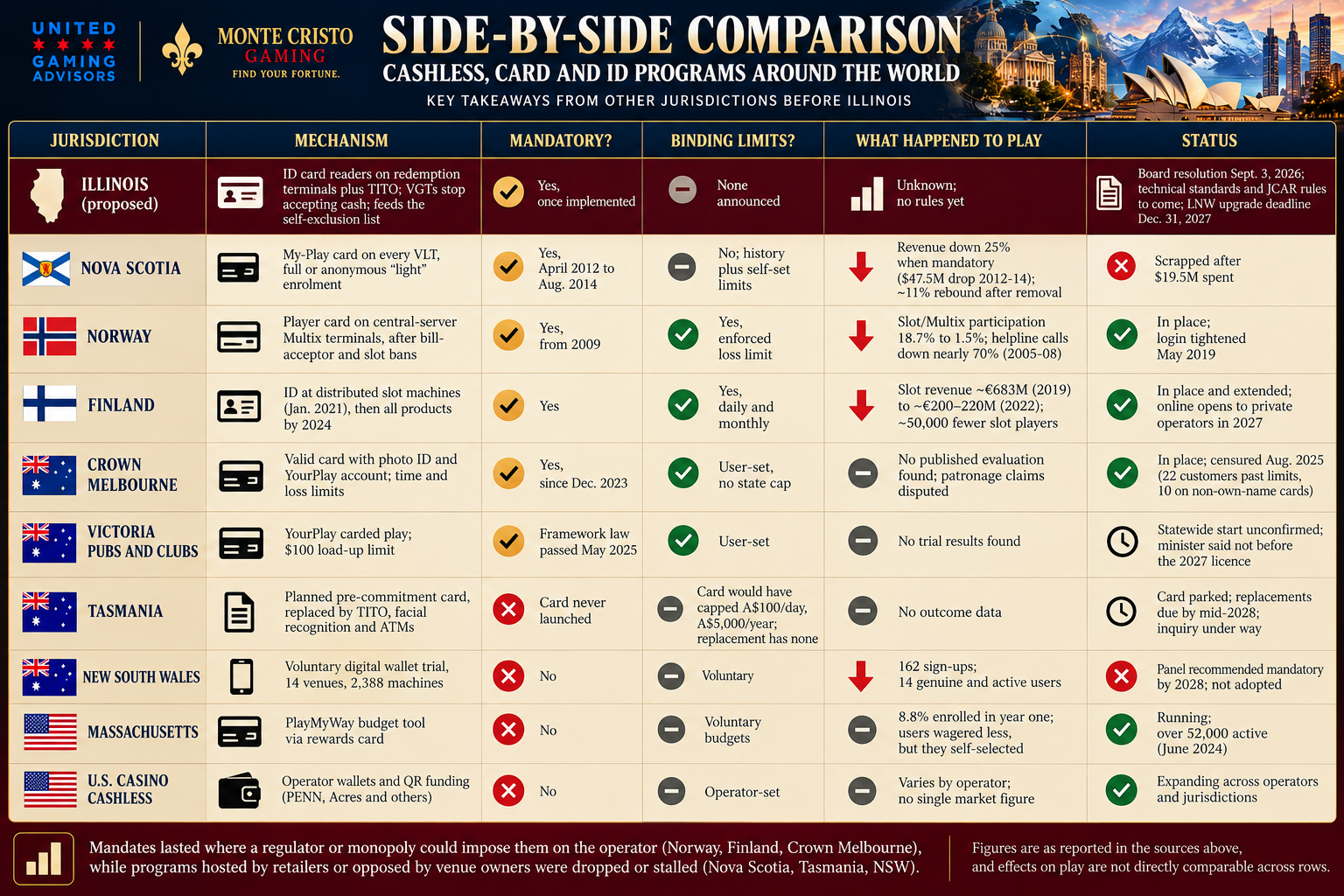
Mandates lasted where a regulator or monopoly could impose them on the operator (Norway, Finland, Crown Melbourne), while programs hosted by retailers or opposed by venue owners were dropped or stalled (Nova Scotia, Tasmania, NSW). Figures are as reported in the sources above, and effects on play are not directly comparable across rows.
Illinois (proposed). Mechanism: ID card readers on redemption terminals plus TITO; VGTs stop accepting cash; feeds the self-exclusion list. Mandatory? Yes, once implemented. Binding limits? None announced. What happened to play: Unknown; no rules yet. Status: Board resolution Sept. 3, 2026; technical standards and JCAR rules to come; LNW upgrade deadline Dec. 31, 2027.
Nova Scotia. Mechanism: My-Play card on every VLT, full or anonymous "light" enrolment. Mandatory? Yes, April 2012 to Aug. 2014. Binding limits? No; history plus self-set limits. What happened to play: Revenue down 25% when mandatory (provincial corporation); $47.5M drop 2012-14 (government); about 11% rebound after removal. Status: Scrapped after $19.5M spent.
Norway. Mechanism: Player card on central-server Multix terminals, after bill-acceptor and slot bans. Mandatory? Yes, from 2009. Binding limits? Yes, enforced loss limit. What happened to play: Slot/Multix participation 18.7% to 1.5%; helpline calls down nearly 70% (2005-08). Status: In place; login tightened May 2019.
Finland. Mechanism: ID at distributed slot machines (Jan. 2021), then all products by 2024. Mandatory? Yes. Binding limits? Yes, daily and monthly. What happened to play: Slot revenue about €683M (2019) to about €200-220M (2022); about 50,000 fewer slot players. Status: In place and extended; online opens to private operators in 2027.
Crown Melbourne. Mechanism: Valid card with photo ID and YourPlay account; time and loss limits. Mandatory? Yes, since Dec. 2023. Binding limits? User-set, no state cap. What happened to play: No published evaluation found; patronage claims disputed. Status: In place; censured Aug. 2025 (22 customers past limits, 10 on non-own-name cards).
Victoria pubs and clubs. Mechanism: YourPlay carded play; $100 load-up limit. Mandatory? Framework law passed May 2025. Binding limits? User-set. What happened to play: No trial results found. Status: Statewide start unconfirmed; minister said not before the 2027 licence.
Tasmania. Mechanism: Planned pre-commitment card, replaced by TITO, facial recognition and ATMs. Mandatory? Card never launched. Binding limits? Card would have capped A$100/day, A$5,000/year; replacement has none. What happened to play: No outcome data. Status: Card parked; replacements due by mid-2028; inquiry under way.
New South Wales. Mechanism: Voluntary digital wallet trial, 14 venues, 2,388 machines. Mandatory? No. Binding limits? Voluntary. What happened to play: 162 sign-ups; 14 genuine and active users. Status: Panel recommended mandatory by 2028; not adopted.
Massachusetts. Mechanism: PlayMyWay budget tool via rewards card. Mandatory? No. Binding limits? Voluntary budgets. What happened to play: 8.8% enrolled in year one; users wagered less, but they self-selected. Status: Running; over 52,000 active (June 2024).
U.S. casino cashless. Mechanism: Operator wallets and QR funding (PENN, Acres and others). Mandatory? No. Binding limits? Operator-set. What happened to play: No independent data; vendor study claims 92% more credits per session. Status: Spreading.
What this means for Illinois operators
The record says voluntary tools reach a few percent of players and mandatory ones change who plays, so the open question for Illinois is design rather than whether the system works. This section is analysis, not legal advice.
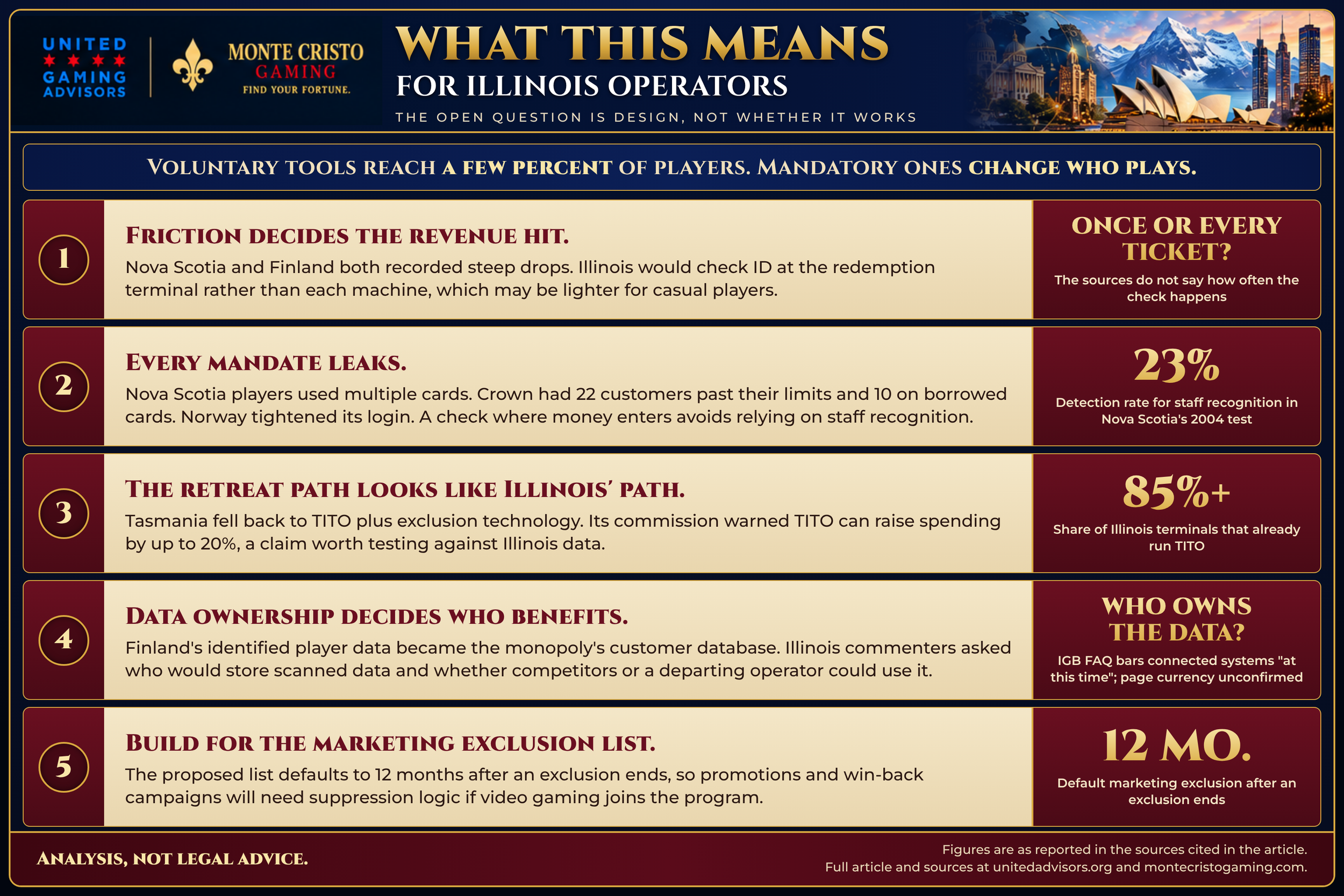
Friction decides the revenue hit. Nova Scotia and Finland both recorded steep drops, and Victoria's minister tied Crown's ID rule to losing casual tourists. Illinois' plan checks ID at the redemption terminal rather than at each machine, which may be lighter for casual players. The sources do not say whether the check happens once or on every ticket purchase.
Every mandate leaks. Nova Scotia players used multiple cards, Crown had 22 customers past their limits and 10 on borrowed cards, and Norway tightened its login. A check where money enters, as idPair proposed, avoids the 23% detection rate staff recognition managed in Nova Scotia's 2004 test.
The retreat path looks like Illinois' path. Tasmania fell back to TITO plus exclusion technology. Illinois already has TITO on over 85% of terminals, and Tasmania's commission warned TITO can raise spending by up to 20%, a claim worth testing against Illinois data.
Data ownership decides who benefits. Finland's identified player data became the monopoly's customer database. Illinois commenters asked who would store scanned data and whether competitors or a departing operator could use it. The IGB's video gaming FAQ says systems that connect to the VGT in any way are prohibited "at this time"; I could not confirm that page is current.
Build for the marketing exclusion list. The proposed Marketing Exclusion List defaults to 12 months after an exclusion ends, so promotions and win-back campaigns will need suppression logic if video gaming joins the program.
What to watch
The IGB's technical standards and proposed implementing rules, the six-to-twelve-month JCAR review of the SEP amendments, the next board meeting on Dec. 10, 2026, and LNW's Dec. 31, 2027 upgrade deadline. I found no coverage yet of the Oct. 22, 2026 board meeting.
Sources
Pages opened in full are marked with an asterisk; the rest were read from search excerpts, so check figures there before relying on them.
Illinois: IGB release, Sept. 8, 2026, Capitol News Illinois via WJBD, Fox Rothschild, September 2026 recap, IGB release, Oct. 2024, public comments to the IGB*, IGB video gaming FAQ, IGB April 2025 rules, Fox Rothschild, Feb. 2026 recap (via CB Insights), IGB TITO notice
Nova Scotia: Government release, Aug. 2014, CBC, cards abandoned, CBC, creator's response, CBC, Steele, CBC, revenue 2016, CBC, committee hearing, Nova Scotia Gaming overview, Global News, 2011, Focal Research, 2004 process test
Norway: Engebø, Torsheim and Pallesen, 2021*, Norsk Tipping follow-up to regulator audit (Norwegian)
Finland: Deloitte, Veikkaus 2023 results, Yogonet, Helsinki Times
Victoria: Parliament of Victoria debate, May 27, 2025, Parliament of Victoria news, VGCCC, Crown censure, Premier of Victoria, trial, Crown Melbourne carded play, iGaming Business
Tasmania: ABC, July 2026*, Pulse Tasmania, Focus Gaming News, Global Gaming Insider
New South Wales: NSW Government trial page, ABC, Wests trial*, ABC, panel report, NEXT.io, ASGAM, GamblingNews
United States: MGC Responsible Gaming Framework 2.0, MGC FY2024 report, MGC 2023 report, Division on Addiction PlayMyWay report, Nevada Independent
Analysis, not legal advice. Monte Cristo Gaming is an Illinois video gaming terminal operator (Illinois Gaming Board licensing in process). 21+. Please play responsibly. If you or someone you know has a gambling problem, call or text 1-800-GAMBLER.
