

Every Pennsylvania Skill-Games Bill, Side by Side, and Our Odds on October 13
United Gaming Advisors — September 24, 2026. Chris Schink is also the founder of Monte Cristo Gaming, Illinois's premium video gaming terminal operator.
Nineteen days before the Supreme Court's deadline, Pennsylvania has nine skill-games proposals on the table: eight regulatory frameworks and one stopgap. None has passed either chamber. Here's what each proposal actually does, followed by what we think happens.
The bills
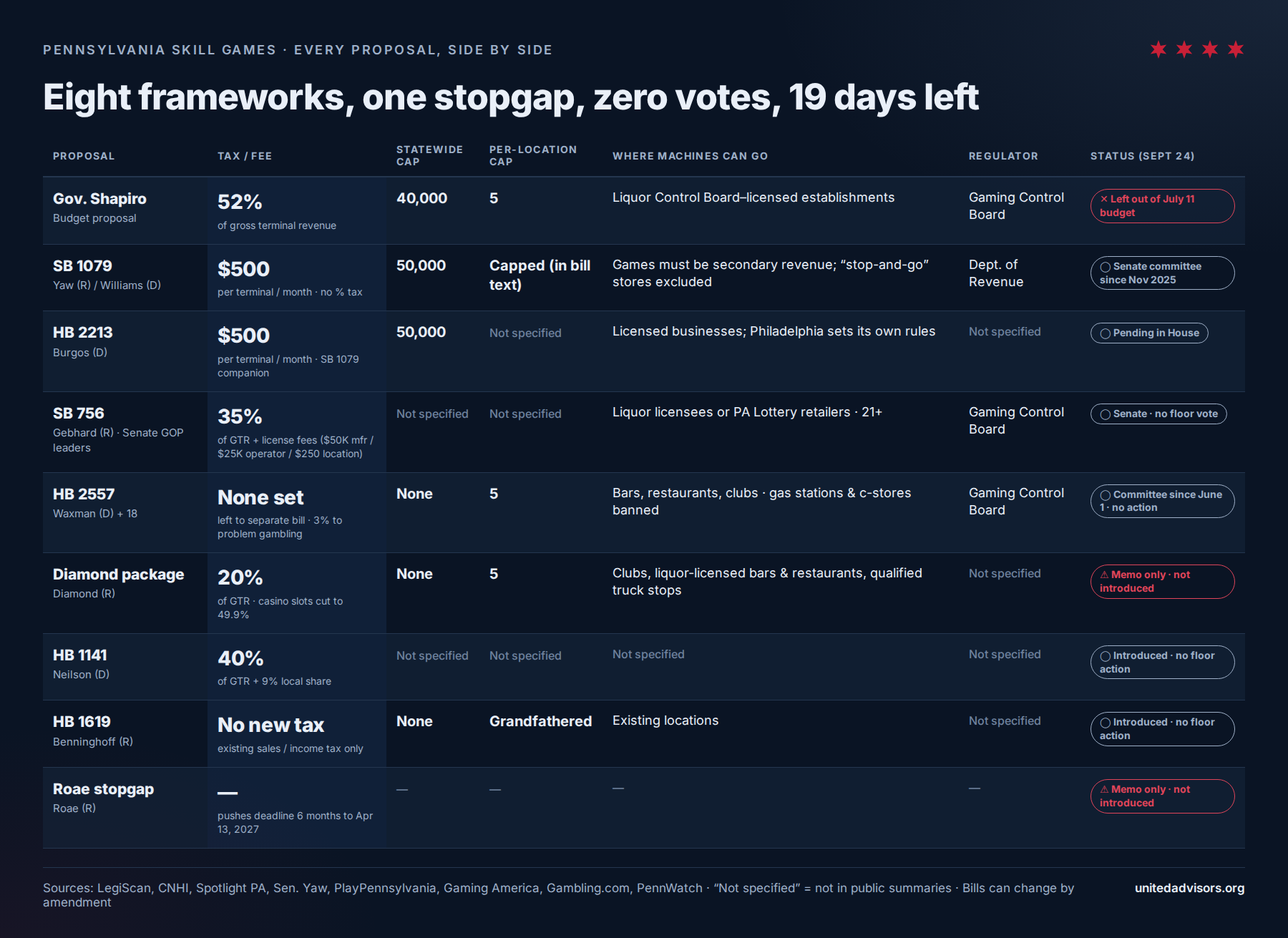
ProposalTax / feeStatewide capPer-location capWhere machines can goRegulatorStatus (Sept 24)Gov. Shapiro (budget proposal)52% of gross terminal revenue40,0005Liquor Control Board–licensed establishmentsGaming Control BoardLeft out of the budget signed July 11SB 1079, Yaw (R) / Williams (D)$500 per terminal per month, no % tax50,000Capped (number set in bill text)Games must be a secondary revenue source; "stop-and-go" stores excludedDept. of RevenueSenate committee since Nov 11, 2025HB 2213, Burgos (D)$500 per terminal per month (House companion to SB 1079)50,000Not specifiedLicensed businesses; Philadelphia gets its own rulemaking powerNot specifiedPending in HouseSB 756, Gebhard (R), backed by Senate GOP leaders35% of GTR + licenses: $50K manufacturer, $25K operator, $250 establishmentNot specified (leadership framework reported ~35,000 machines)Not specifiedLiquor licensees or PA Lottery retailersGaming Control BoardSenate; no floor voteHB 2557, Waxman (D) + 18 co-sponsorsNone set (left to separate legislation); 3% to problem gamblingNone5Bars, restaurants, fraternal clubs. Gas stations and convenience stores bannedGaming Control BoardHouse Gaming Oversight since June 1; no actionRep. Diamond package20% of GTR, and casino slots cut to 49.9%None5Clubs, liquor-licensed bars/restaurants, qualified truck stopsNot specifiedCo-sponsor memo (Sept 1); not introducedHB 1141, Neilson (D)40% of GTR + 9% local shareNot specifiedNot specifiedNot specifiedNot specifiedIntroduced; no floor actionHB 1619, Benninghoff (R)No new tax (existing sales/income tax only)NoneExisting machines grandfatheredExisting locationsNot specifiedIntroduced; no floor actionRep. Roae (stopgap)n/a: pushes the deadline six months to April 13, 2027n/an/an/an/aCo-sponsor memo (Sept 15); not introduced
Player protections worth knowing: HB 2557 is the most detailed, with a $5 max bet, $1,000 max payout, 85% minimum return to player, daily loss limits, a 30-second timeout every 15 minutes, and inclusion in the state self-exclusion list. SB 756 also caps play at $5 and prizes at $1,000 and sets the age at 21+. SB 1079 requires ID to play and a central monitoring system.
Revenue claims: Shapiro ~$766M in year one (and up to $1.2B long-term per the IFO) · SB 1079 / HB 2213 ~$300M · Diamond up to ~$1B, with 79% going to property-tax relief.
What the table tells you
1. The real split is fee vs. percentage. SB 1079 and HB 2213 charge a flat $500 per terminal per month. Everyone else taxes revenue, at rates from 20% to 52%. A flat fee rewards high-performing machines; a percentage tax spreads the pain. Where your locations sit on performance decides which one you'd rather have.
2. Rate range: 0% to 52%. Excluding the no-tax grandfather bill, the gap is still 20% (Diamond) to 52% (Shapiro). Nobody closes a 32-point spread in six voting days.
3. Five per location is the emerging consensus. Shapiro, Waxman and Diamond all land at five. SB 1079 caps locations too. If a deal happens, plan on five.
4. Convenience stores and gas stations are the most exposed. HB 2557 bans them outright. SB 1079 excludes "stop-and-go" stores and requires games to be secondary revenue. Shapiro and SB 756 tie eligibility to liquor or lottery licenses. Most of today's machines sit in exactly those venues.
Our odds
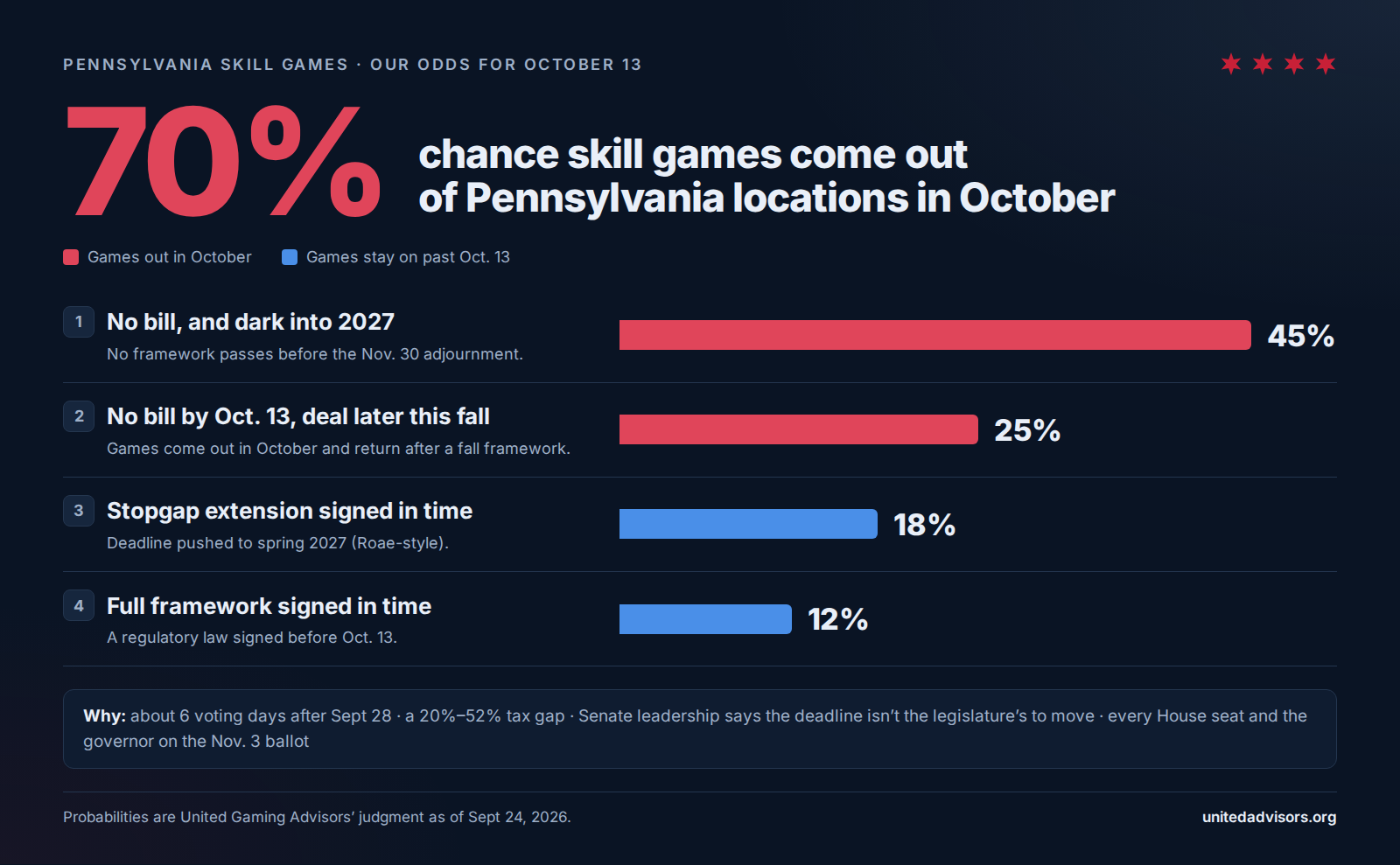
Probabilities as of September 24, 2026. The legislature doesn't return until September 28, which leaves roughly six voting days before October 13, five weeks before the November 3 election.
OutcomeProbabilityNo bill. Games come out in October, and no framework passes this session (the market stays dark into 2027)45%No bill by Oct. 13. Games come out in October, but a framework passes later this fall (before the Nov. 30 adjournment)25%Stopgap extension signed before Oct. 13 (games stay on through spring 2027)18%Full regulatory framework signed before Oct. 1312%
Bottom line: a 70% chance that skill games come out of Pennsylvania locations in October.
Why so high:
The calendar. About six voting days, two chambers and a governor's signature.
The gap. Four serious frameworks that don't agree on tax model, rate or eligibility.
The extension is not a clean fix. Senate Majority Leader Pittman has said October 13 flows from the Supreme Court's ruling, not from the legislature. Roae's proposal hasn't even been introduced yet.
Election-year politics. Every House seat and the governor's office are on the November ballot. A tax vote on "gas station slots" five weeks out is a hard vote.
The budget already failed the test. The July budget was the best vehicle for a deal, and skill games were left out.
If a framework does pass, this fall or in 2027, our bet on its shape is the SB 1079 / HB 2213 fee chassis, with a higher fee or a modest percentage layered on, five machines per location, tighter eligibility for convenience stores and gas stations, and Waxman-style player protections. Shapiro's 52% is the opening bid, not the landing spot.
What to do now
Plan for October 13 as written. State Police guidance says machines must be physically removed, not just unplugged. Get your vendor's removal plan in writing.
Protect the liquor license. The Tavern Association warns that a machine left on premises after the deadline could put a location's liquor license at risk, beyond the machine itself.
Model the fee and the tax separately. $500 a month per machine versus 20–35% of revenue can flip which locations are worth keeping.
Convenience stores and gas stations: assume you're outside whatever framework eventually passes, and plan accordingly.
Need a location-by-location read on what each bill would mean for your route? Book a consultation.
Sources: CNHI, June 16 bill roundup · Spotlight PA / State College, proposals & hurdles · Sen. Yaw, SB 1079 announcement · LegiScan SB 1079 · LegiScan HB 2557 · Gaming America, HB 2557 · PlayPennsylvania, SB 756 · Gambling.com, Diamond plan · Broad + Liberty, 52% hearing · PennWatch, Roae memo · Lancaster Online, PSP guidance
Caveat on the table: HB 2213's per-location cap, SB 1079's exact per-location number, and HB 1141/HB 1619's committee status weren't in any public summary we could access. Those cells say "not specified" or "introduced" instead of guessing. Bill text can change by amendment at any time.
