

Pennsylvania Has 15 Days Left. All Three Skill-Games Bills Are Still Stuck in the Same Committees They Started In.
United Gaming Advisors — September 28, 2026. Chris Schink is also the founder of Monte Cristo Gaming, Illinois's premium video gaming terminal operator.
Key Takeaways for Gaming Operators and Advisors
Pennsylvania has 15 calendar days left before the October 13 skill-games enforcement deadline, and we checked all three live bills against the General Assembly's own records today: none of them has cleared its committee of origin.
HB 2213 has been in House Gaming Oversight since February 11. HB 2557 has been there since June 1. SB 1079 has been in Senate Community, Economic & Recreational Development since November 11, 2025 — nearly 11 months. Zero committee votes on any of them.
The deadline-extension push is now bipartisan — Rep. Brad Roae (R) and Rep. Manuel Guzman (D) both filed memos proposing an April 13, 2027 extension — but neither has a bill number yet.
Chicago VGT, checked against the Illinois Gaming Board's own data today: 64 state-licensed locations, 287 pending applications, still zero city licenses and zero terminals live. We also traced why the city side is frozen: its own fix for the bottleneck has been stalled in the City Council since April.
Two standing corrections: Virginia didn't just "stall" on skill games — a bill reached the Governor's desk and was vetoed. Nebraska already raised its skill-game tax this year; it isn't only a sports-betting story there.
Fifteen days. That's what's left on the calendar before Pennsylvania's skill-game machines become subject to seizure statewide, and we spent part of today doing something simple that's easy to skip when a story has been running for weeks: we went back to the General Assembly's own bill-history pages and checked, one by one, whether any of the three bills currently associated with a fix has actually moved. None has.
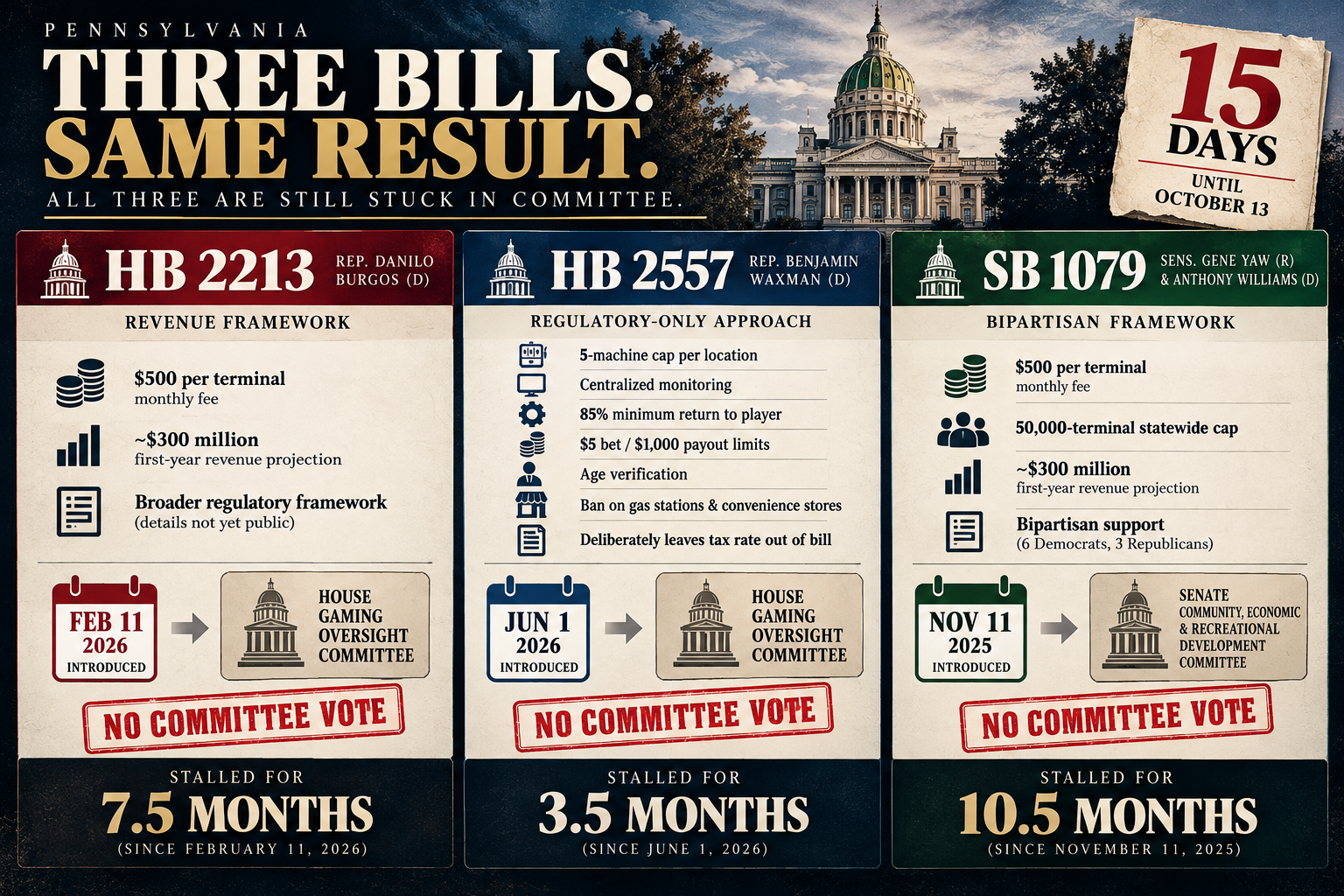
HB 2213, Rep. Danilo Burgos's vehicle carrying the $500-per-terminal fee and roughly $300 million first-year revenue projection, was introduced and referred to House Gaming Oversight Committee on February 11 — seven and a half months ago. HB 2557, Rep. Ben Waxman's "Skill Game Consumer Protection Act" with 18 Democratic co-sponsors, took a different approach when it was introduced June 1: it adopts Pennsylvania's existing VGT regulatory framework almost wholesale — a five-machine cap per location, centralized monitoring, an 85% minimum return-to-player, $5 bet and $1,000 payout limits, age verification, and a ban on gas-station and convenience-store placement — while deliberately leaving the tax rate out of the bill entirely, betting that separating regulation from taxation (the way VGT legalization actually happened in 2017) gives it a better shot than an all-in-one package. It, too, has not had a committee vote since its June 1 referral. And SB 1079, Sen. Gene Yaw's bipartisan bill (six Democrats, three Republicans signed on), has been parked in the Senate's Community, Economic & Recreational Development Committee since November 11 of last year — the longest-stalled of the three.
Here's the thing worth saying plainly to clients: this isn't a story about disagreement over language on the floor. It's that nothing has left committee. Three different approaches, three different committees, zero votes. That's a different — and more sobering — picture than "lawmakers are negotiating."
The extension push picked up a second name this week, but still no bill number. Rep. Brad Roae (R-Crawford), who's been circulating his six-month-extension memo for weeks, was joined by Rep. Manuel Guzman (D-Berks) filing a parallel memo — both propose pushing the deadline to April 13, 2027 while negotiations continue. Roae's read on the odds hasn't changed: "It is unlikely that legislation to make skill games legal, establish a tax rate, establish regulations and decide how to spend the revenue will get done by Oct. 13." As of today, neither memo has become an actual bill with a number. There's also a fourth, separate proposal worth knowing about so it doesn't get confused with the extension: Rep. Russ Diamond has circulated his own memo proposing a 20% tax on skill-game revenue and confining machines to clubs, bars, liquor-licensed restaurants, and truck stops — removing them from gas stations and convenience stores. It hasn't moved either, and it's a different bill from the extension proposals, not an alternate name for the same thing.
Pennsylvania State Police's standing guidance — physically remove noncompliant machines by October 13, don't just power them down — is unchanged and still the operative instruction until the legislature does something to supersede it. Pace-O-Matic continues warning that host locations like VFWs and American Legions will have to cut staff or close without the machines.
For clients: don't plan around a deal materializing. With 15 days left and no committee votes on any live bill, the realistic scenarios are a late floor maneuver nobody has filed yet, the Roae/Guzman extension actually getting a bill number and moving before October 13, or the deadline simply arriving and the removal guidance becoming the default rule. Plan around the committee calendar, not the interview quotes.
Chicago VGT: checked against the source again, and we traced the actual bottleneck
Pulling directly from the Illinois Gaming Board's own licensee and applicant data today: 64 Chicago establishment licenses hold state approval (down one from Friday's 65 — we looked for a matching revocation in the IGB's own records and didn't find one; this reads as normal weekly churn, not a signal) against 287 pending applications (285 Establishment, 1 Veterans, 1 Truck Stop — up one from Friday's 286). The city itself still hasn't issued a single local license, so despite 64 state-approved locations sitting ready, zero terminals are operating in Chicago.
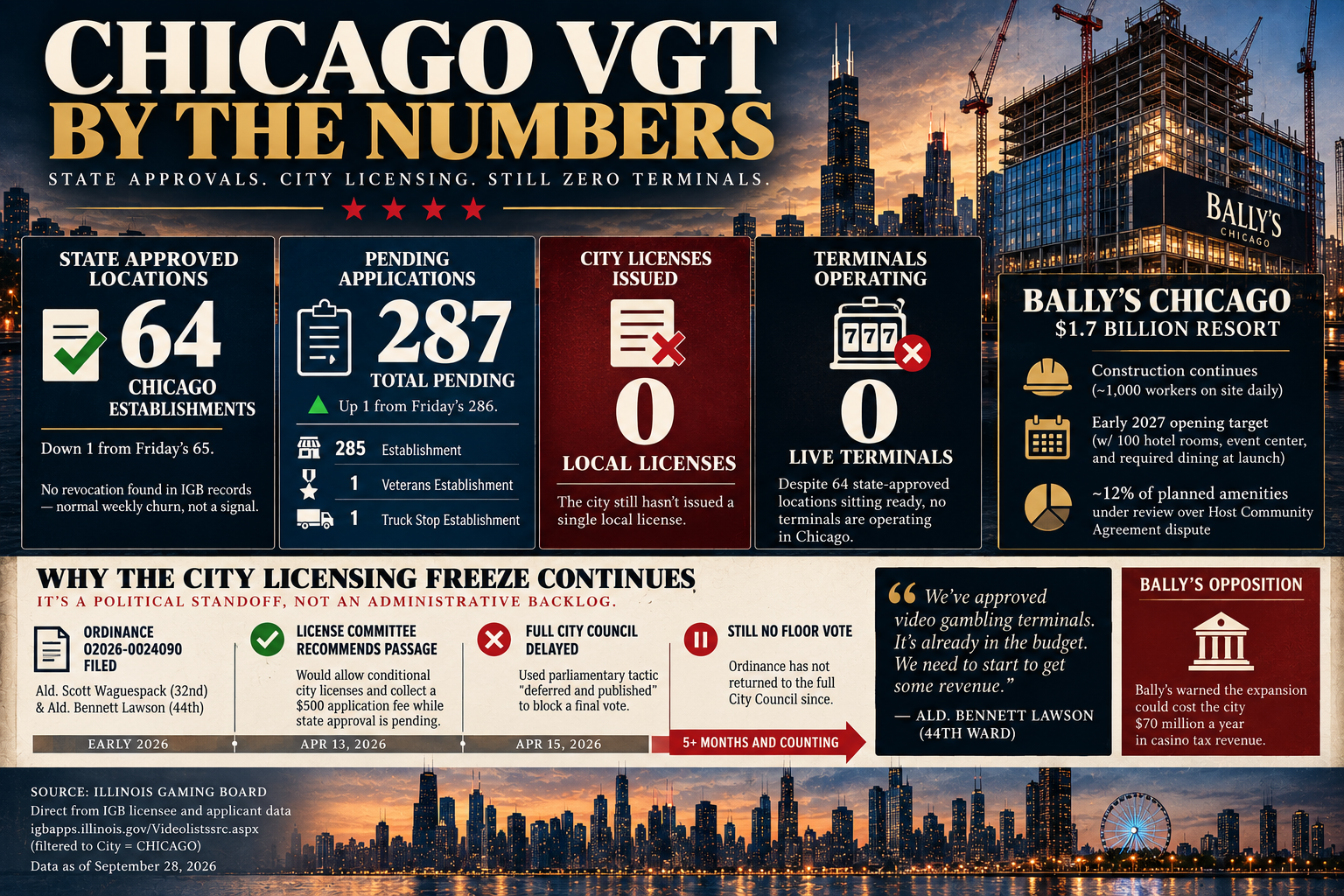
We went a step further today and looked into why the city side is frozen, because "the city hasn't licensed anyone yet" undersells what's actually happening. Chicago has its own proposed fix — Ordinance O2026-0024090, sponsored by Ald. Scott Waguespack (32nd) and Ald. Bennett Lawson (44th) — that would let businesses get a conditional city license, and let the city start collecting its $500 application fee, while state approval is still pending, the same way Chicago already handles liquor licensing. The License and Consumer Protection Committee recommended it for passage on April 13. Two days later, the full City Council used a parliamentary delay tactic — "deferred and published" — to block a final vote, and the ordinance hasn't come back to the floor since. Ald. Lawson's case at the time: "We've approved video gambling terminals. It's already in the budget. We need to start to get some revenue." Bally's opposed the expansion, warning it could cost the city $70 million a year in casino tax revenue. That fight — not administrative backlog — is the real reason the city licensing freeze persists, more than five months later.
Bally's itself had nothing new to report since its September 23 update: construction on the $1.7 billion casino continues with roughly 1,000 workers on site daily, the early-2027 opening target holds, and about 12% of planned amenities remain under review amid the Host Community Agreement dispute.
The rest of the map
Missouri stayed quiet on new filings, but we tightened up something worth knowing: the state's own video-lottery bill wasn't killed on the floor, as we've described before — it was killed by a Senate committee vote on May 6. That distinction matters for planning purposes, since a committee kill is generally an easier thing to revisit next session than a floor defeat. AG Catherine Hanaway's enforcement campaign against "gray market" machines remains active, with at least two lawsuits pending in Cole County Circuit Court challenging how the crackdown has been carried out.
Georgia and Texas produced nothing new. San Antonio's eight-liner ban, filed September 9, still has no committee hearing date 19 days later. Nevada, West Virginia, Montana, and Oregon were quiet across the board.
Two corrections, because accuracy matters more than momentum
We've described Virginia in prior updates as "stalled on an independent gaming-commission precondition." That undersold the real story: SB 661, which would have legalized skill-gaming devices statewide, actually passed the General Assembly — and was vetoed by Governor Spanberger on April 10, 2026. Her stated reasons included the absence of a single independent gaming regulator, enforcement strain from adding thousands of machines to a fragmented system, evidence that skill machines cluster in lower-income and higher-minority communities, and a concern about rewarding operators who'd ignored state law for years. The Gaming Commission proposal is real and separate, and still not operational — but the headline fact is that a bill reached the Governor's desk and died there, not that the legislature never got around to voting.
And we've repeatedly described Nebraska as focused only on an online sports-betting ballot measure, with no distributed-gaming action. That's also incomplete: Nebraska already passed LB 901 this year, roughly doubling the tax on skill-game profits from 5% to 10% and raising licensing fees, signed by Governor Pillen on April 7. About $7 million of the state's projected new revenue next year comes from that tax increase alone, and the state's skill-game machine count has grown from roughly 300 in 2007 to about 6,000 today. If you have machines in Nebraska, the tax framework already changed — it's not a wait-and-see market on the distributed-gaming side.
Want a live read on where your operation stands under any of these frameworks — Pennsylvania, Illinois, Virginia, Nebraska, or anywhere else we track? Reach out.
